
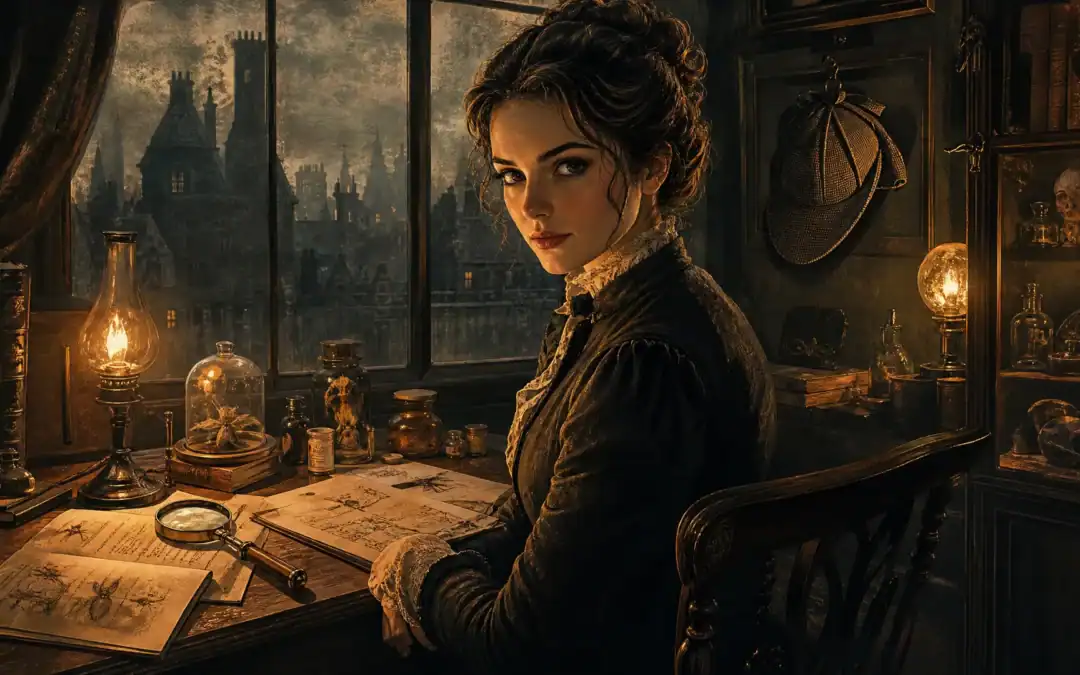
If you’ve spent any time with Sherlock Holmes adaptations, BBC dramas, Hollywood films, endless podcast retellings, you’ve probably noticed something. Holmes is always at the centre, and the people around him are always supporting acts. Lucy James, Sherlock Holmes’s daughter, changes that entirely. She’s not a sidekick or a cameo. She’s the protagonist, the detective, the heir, and she arrives with a claim on the canon that gets harder to dismiss the more closely you read Conan Doyle.
Who Is Lucy James? Introducing Holmes’s Unknown Daughter
The premise: a daughter hidden in the gaps of the canon
Lucy James is the central character of the Sherlock and Lucy series, a young woman who discovers, in the opening pages of the first book, that Sherlock Holmes is her father. The premise sounds bold, but it earns its place. Conan Doyle left Holmes’s personal life deliberately sparse. There are no wives, no children, almost no family beyond a brother. That silence isn’t a closed door. For writers who respect the canon rather than raiding it for spectacle, it’s an open invitation.
The Sherlock and Lucy series steps through that door carefully, asking: what if Holmes fathered a child he never publicly acknowledged? What would that daughter inherit, and what would she have to build for herself?
Lucy’s voice and what makes her perspective distinctive
Lucy narrates her own story, and that choice matters. She sees London, crime, and her extraordinary father through eyes that are sharp but not cold. She has Holmes’s deductive instincts, the quick read of a room, the pattern spotted before anyone else has looked twice, but she also carries an emotional life that Holmes himself famously suppressed. Where Holmes retreats into logic as armour, Lucy uses both logic and feeling as tools. That combination gives the series a texture that feels genuinely different from the Holmes stories without ever betraying them.
Sherlock Holmes Family Canon: What Conan Doyle Actually Left Us
Mycroft and the limits of Holmes’s known family
The only relative Holmes discusses with any regularity in Conan Doyle’s stories is his brother Mycroft, who appears in “The Greek Interpreter” and “The Bruce-Partington Plans.” Mycroft is brilliant, indolent, and indispensable to the British government, and he tells us almost nothing about the broader Holmes family. There’s a passing mention that Holmes’s grandmother was a sister of the French artist Vernet, which hints at the family’s artistic and observational gifts. Beyond that, the paternal and maternal lines are almost entirely unexplored.
Why the canon is silent on daughters, and why that silence matters
Conan Doyle’s Holmes is famously guarded about his personal life. He treats emotion as a distraction from pure reason, avoids domestic entanglements, and gives Watson only the barest glimpses behind the professional mask. This is a deliberate authorial choice, and it means that absence of family isn’t the same as confirmed absence. Holmes having an unacknowledged daughter doesn’t contradict the canon. It explains certain silences within it. That distinction, between contradiction and expansion, is what makes the Lucy James premise feel canonical rather than fanfiction-loose.
Lucy James’s Character Backstory: Built from the Canon Up
Her inherited traits: observation, deduction, determination
The Sherlock and Lucy series is co-written by Charles Veley and Anna Elliott. Veley provides the plot architecture, the cases, the puzzles, the pacing, while Elliott shapes Lucy’s voice and emotional interiority. That dual-author structure is itself part of what makes Lucy feel fully realised. She isn’t a sketch of Holmes with a different gender. She’s a woman built from Holmesian raw material and then developed outward from there.
Her deductive instincts read as inherited, she notices what others miss, draws connections quickly, and feels a physical discomfort when a problem goes unsolved. But her determination has a different source. Holmes can afford to be eccentric and antisocial; his reputation protects him. Lucy operates in a world that is less forgiving of a young woman who asks inconvenient questions and refuses to be steered away from danger.
Growing up outside Baker Street, the backstory explained
Lucy did not grow up knowing who her father was. That backstory, the years outside Baker Street, the mother’s silence, the gradual discovery of her own identity, is where the series does some of its most interesting work. The emotional weight of meeting a brilliant, difficult father as an adult, rather than growing up in his shadow, gives Lucy a kind of hard-won independence. She doesn’t need Holmes to validate her. She wants to understand him, and to be understood in return, and those are rather different things.
Female Detectives in the Holmes Universe: A Tradition Hiding in Plain Sight
It’s easy to think of Victorian detective fiction as entirely male territory, but the history pushes back on that quickly. Catherine Louisa Pirkis published The Experiences of Loveday Brooke, Lady Detective in 1894, while Doyle was actively writing Holmes. Mary Fortune was publishing detective fiction in Australia from the 1860s onward. Women detectives existed in the literature of the era; they were simply written out of the popular memory that formed around Holmes’s dominance.
Within the Holmes canon itself, the closest thing to a female peer for Holmes is Irene Adler. She appears in just one story, “A Scandal in Bohemia,” and Holmes calls her “the woman”, the single person who outwitted him. It’s a remarkable designation for a character who gets exactly one appearance. Doyle gave us proof of concept and then moved on.
Women detectives in the Sherlock universe have appeared in various adaptations since, but usually as secondary figures or one-arc characters. Lucy James is something more systematic: a female detective who applies the full Holmesian method across an entire series, in her own right, with her own recurring cast and developing arc. She’s the logical heir to Irene Adler’s precedent, and to the broader Victorian tradition of women detectives that fiction has been too slow to recover.
Why Holmes’s Unknown Daughter Resonates with Readers Today
Classic Holmes adaptations have, with a few honourable exceptions, centred men. Watson is male. Lestrade is male. The clients, the villains, the rivals, the world of Baker Street defaults to masculine perspectives almost entirely. Readers who love the puzzle-solving, the historical atmosphere, and the pleasure of a well-constructed mystery have often had to accept that they’re reading themselves into a world that wasn’t designed with them in mind.
Lucy James addresses that gap directly. She’s not a gender-swapped Holmes, she’s a character who experiences Victorian London as a woman actually would, with all the constraints and stratagems that entailed. She has to be cleverer in some rooms because she’s less expected. She reads people with the kind of attention that comes from years of navigating a world that underestimates you. Readers, particularly women who grew up loving Holmes and wondering where they fit in his world, recognise that experience immediately.
There’s also the family dynamic itself. Holmes and Lucy’s relationship is neither simple nor sentimental. It’s two extraordinarily observant people trying to understand each other across a gulf of years and secrets. That emotional architecture, played out against the backdrop of Victorian London’s real social machinery, gives the series a richness that pure detective plots rarely achieve.
Where to Begin: The Sherlock and Lucy Series Reading Order
The Sherlock and Lucy novels are designed to be read in order. Each book builds on what came before, Lucy’s confidence grows, her relationship with Holmes deepens, and the cases become more intricate as the series progresses. Starting at the beginning means you meet Lucy when she does: uncertain, sharp, and determined to find out who she is.
If you’re deciding whether the series is for you, the first book is the right test. It sets the tone, introduces the key relationships, and delivers a complete mystery while laying the groundwork for everything that follows. Think of it as the first episode of a series you’ll want to binge, except that each instalment is a proper novel with room to breathe.
For readers who want to understand how Lucy James fits into the wider world of Holmes continuation fiction, a good companion resource is the best Sherlock Holmes continuation novels worth reading, a guide that puts the Sherlock and Lucy series in context alongside other worthy additions to the extended canon.
The series is a long project, and a rewarding one. If you love Conan Doyle’s originals, Lucy James will feel like a discovery you should have made years ago, a character who was always implied by the canon, waiting for someone to finally write her into existence.
Recent Comments