
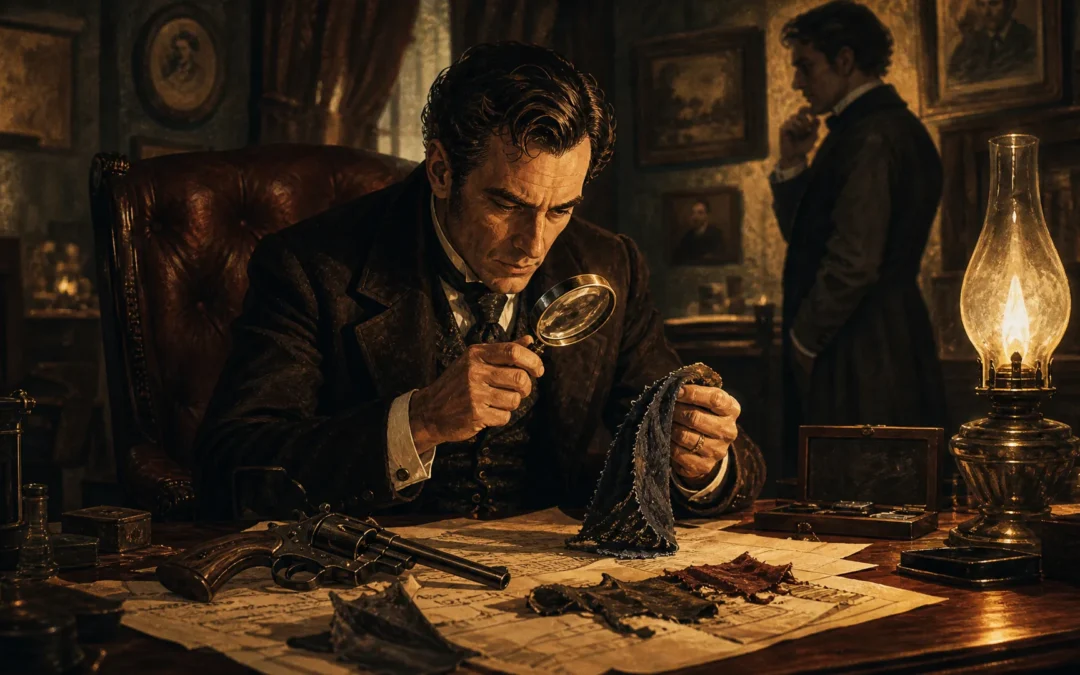
Few characters in literary history have left a structural mark as deep as Sherlock Holmes. When Arthur Conan Doyle published A Study in Scarlet in 1887, he wasn’t just introducing a brilliant detective, he was laying the foundation for how detective fiction would be written, read, and argued over for the next century and a half. Tracing how Sherlock Holmes stories inspired modern detective fiction means following a line that runs through Agatha Christie’s parlors, Raymond Chandler’s rain-soaked streets, and straight into the television screens of 2026.
The Blueprint Holmes Left Behind: Defining the Detective Genre
The Core Innovations Doyle Introduced
Before Holmes, detective fiction existed, Poe’s Dupin stories are the obvious precursor, but it had no settled grammar. Doyle gave it one. He established structural innovations that writers have worked within, against, or around ever since.
The first is the method of deduction as spectacle. Holmes doesn’t just solve crimes; he performs reasoning for the reader, narrating his logic so the audience can follow, and marvel. This made the detective’s mind the true subject of the story, not simply the crime itself.
The second is the narrator-as-foil. Watson is not a passive record-keeper. He represents the reader’s perspective: intelligent, capable, but not extraordinary. His presence gives Holmes scale. Without Watson’s honest bewilderment, Holmes’s brilliance has nothing to measure itself against.
The third is the eccentric genius as social outsider. Holmes is brilliant precisely because he is apart from ordinary life, he doesn’t want a conventional career, a conventional social circle, or conventional motivations. His detachment is the price of his insight.
Why the Holmes Formula Became the Genre Template
These elements, demonstrable reasoning, the companion-narrator, and the outsider detective, turned out to be remarkably durable. They gave writers a starting architecture that readers immediately understood. The formula also raised the ethical stakes: by centering the detective’s inner life, Doyle made moral complexity available to the genre in a way that pure puzzle fiction couldn’t sustain.
Later writers found the template generous. You could honor it, as Christie did. You could invert it, as Chandler did. You could transplant it to a new century, as television has done repeatedly. In every case, the Holmes formula was the fixed point the new work defined itself against.
How the Doyle Canon Shaped Classic Detective Fiction Influence in the 20th Century
The Golden Age Writers Who Studied Holmes
Agatha Christie is the clearest example of how directly Doyle’s formula passed to the next generation. Hercule Poirot inherits Holmes’s “great detective” archetype wholesale, the eccentric genius, the dismissal of raw physical evidence in favor of psychological deduction (his famous “little grey cells”), and the loyal foil companion in Captain Hastings. Christie absorbs the template and refines it, shifting the puzzle element toward near-mathematical elegance while keeping Holmes’s core insight: that human behavior, read carefully, is always the real clue.
Dorothy L. Sayers did something similar with Lord Peter Wimsey, adding an aristocratic layer but preserving the outsider’s perspective and the demonstrative reasoning. The Holmes legacy in classic detective fiction is less about imitation than about a shared formal inheritance, the way all sonnet writers share Shakespeare without copying him.
Hard-Boiled Fiction as a Reaction to the Holmes Model
The most telling proof of Holmes’s gravitational pull is that even writers who rejected him couldn’t escape defining themselves in relation to him. Raymond Chandler’s 1944 essay “The Simple Art of Murder” positions the hard-boiled American detective explicitly against the “drawing-room” British puzzle tradition that Holmes helped create. Chandler argued that Doyle’s model was a genteel fiction, too tidy, too cerebral, too disconnected from the actual texture of crime.
But notice what Chandler does: he invents Philip Marlowe as an answer to Holmes, not an escape from him. Marlowe is still morally exceptional, still an outsider, still the smartest person in the room. The differences are real, grit over elegance, street-level observation over pure deduction, but the underlying archetype holds. Rejection, in literary terms, is a form of tribute.
Holmes Legacy in Contemporary Mystery: What Modern Authors Inherit
The Detective as Outsider, A Trope That Persists
In 2026, the Holmes legacy in contemporary mystery is everywhere, even when the name isn’t mentioned. The emotionally detached, hyper-observant investigator who sees what others miss has become one of television’s most reliable protagonists.
The BBC’s Sherlock (2010–2017) and CBS’s Elementary (2012–2019) are the most explicit adaptations, transplanting Holmes to the 21st century while preserving his core traits, the chemical experiments, the social detachment, the need for mental stimulation to ward off darkness. Both shows proved the template survives radical period and setting changes because the essential character logic is what readers and viewers actually care about.
Adrian Monk, from the long-running USA Network series, applies Holmes’s observational superpower to anxiety disorder, showing how the outsider detective trope adapts to contemporary psychology. Netflix’s Enola Holmes centers Holmes’s younger sister, using the established world and method while opening new narrative and gender perspectives.
What all these successors share is the Doyle inheritance: a detective who perceives more than other people do, and pays a social price for it. That tension, the gift inseparable from the isolation, is Doyle’s most enduring contribution to the genre.
Doyle Canon Modern Interpretation: How Continuation Authors Honor the Original
The Art of Writing Within, and Expanding, an Established Canon
The craft challenge facing continuation authors is genuinely difficult. Readers who love the original canon arrive with precise memories, of Holmes’s voice, Watson’s cadences, the specific texture of Baker Street in the 1890s. Any inconsistency, however small, breaks the spell. But pure imitation produces pastiche in the hollow sense: technically accurate, emotionally inert.
The best continuation authors describe the process as a form of deep listening to the source text. The goal isn’t to outdo Doyle but to find the silences in the original stories, the untold cases Watson mentions but never narrates, the secondary characters who deserve more than a paragraph, the perspectives Doyle’s era made invisible. Anthony Horowitz, who has written authorized Holmes continuations, speaks of this as an obligation to the spirit of the stories rather than their letter. The craft requires holding both the constraint and the freedom at once.
Female-Led Narratives as a Natural Evolution of the Holmes Universe
One of the richest spaces in modern Doyle canon interpretation is the addition of female perspectives, not as a revision of Doyle, but as a deepening of the Victorian world he actually built. Victorian London had women of intelligence, agency, and complexity. Doyle’s stories largely place them at the margins. Continuation authors who move women to the center aren’t contradicting the canon; they’re completing it.
The Sherlock and Lucy series by Charles Veley and Anna Elliott takes this approach through Lucy James, Holmes’s daughter and the series’ central narrator. Lucy is a perspective entirely absent from Doyle but entirely consistent with his world-building. She operates within the same London, the same moral atmosphere, the same period detail, but she sees it from a position Doyle never inhabited. The result offers readers new emotional access to the Holmes universe without displacing what they already love.
This is what the best female authors writing Sherlock Holmes pastiches do: they extend the universe’s emotional range by inhabiting its gaps. The strong female characters in Victorian detective fiction that continuation writers have built are not anachronisms, they are corrections to the record.
What Makes a Holmes Pastiche Work: Canon-Respectful Storytelling in 2026
Voice, Period Detail, and the Weight of Reader Expectation
A Holmes pastiche that earns the label “canon-respectful” does several things consistently. First, it gets the voice right, not as slavish imitation of Doyle’s sentence rhythms, but as fidelity to the emotional register. Holmes is dry, quick, occasionally tender, and always precise. Watson is warm, observant, and more capable than he gives himself credit for. Any continuation that loses these proportions loses its readers.
Second, it gets the period right. The Holmes universe is inseparable from its Holmes mysteries set in Edwardian London atmosphere, the fog, the cab horses, the class dynamics, the social constraints that give the mysteries their particular flavor. Anachronistic language, technology, or attitudes don’t just feel wrong; they undermine the logic of the puzzle, because so many Holmes plots depend on the specific affordances and limits of the Victorian world.
Third, and most crucially, a good pastiche adds without replacing. It doesn’t rewrite Holmes as a different kind of person. It doesn’t solve the untold cases in ways that contradict established facts. It finds the open space in the canon, the cases Watson never wrote up, the years between Doyle’s stories, the figures on the edge of the frame, and writes carefully into that space.
What distinguishes this from parody or reimagining is intention and execution. A parody uses the Holmes template to make a point about something else. A reimagining treats the canon as raw material to be reshaped. A canon-respectful continuation treats Doyle’s work as a living world it has been invited to inhabit, and behaves accordingly. The best Holmes books for fans of the original canon consistently share this quality: they feel like they belong in the same library as Doyle’s originals.
Finding Your Next Holmes Adventure: Where the Sherlock Holmes Influence Lives Today
The Sherlock Holmes influence on detective fiction is not a historical footnote. It is the living architecture of a genre that continues to produce remarkable work, in literary crime fiction, in prestige television, and in the growing tradition of continuation novels written by authors who have spent years inside the canon.
For readers who came to detective fiction through Doyle and want to stay close to that spirit, the options in 2026 are generous. The continuation novel tradition has matured considerably, and the best practitioners understand both the craft demands and the reader loyalty involved.
The Sherlock and Lucy series is a natural starting point for readers who value period authenticity, character consistency, and a genuinely new perspective that expands rather than displaces the original. If you’re new to the series, the Sherlock Holmes continuation series reading order is the clearest path in.
For readers who want to explore the wider tradition, there are continuation novels worth reading across a range of styles and approaches, from period-faithful mysteries to more experimental takes on the Holmes world.
The thread connecting all of them runs back to Baker Street. Doyle gave detective fiction not just a great character, but a structural grammar and a moral argument: that close attention to the world, to people, to evidence, to the stories things tell about themselves, is both an intellectual discipline and an ethical act. That argument is still being made, in new voices, in 2026. That is the truest measure of how Sherlock Holmes stories inspired modern detective fiction, and why the inspiration shows no sign of fading.
Recent Comments