
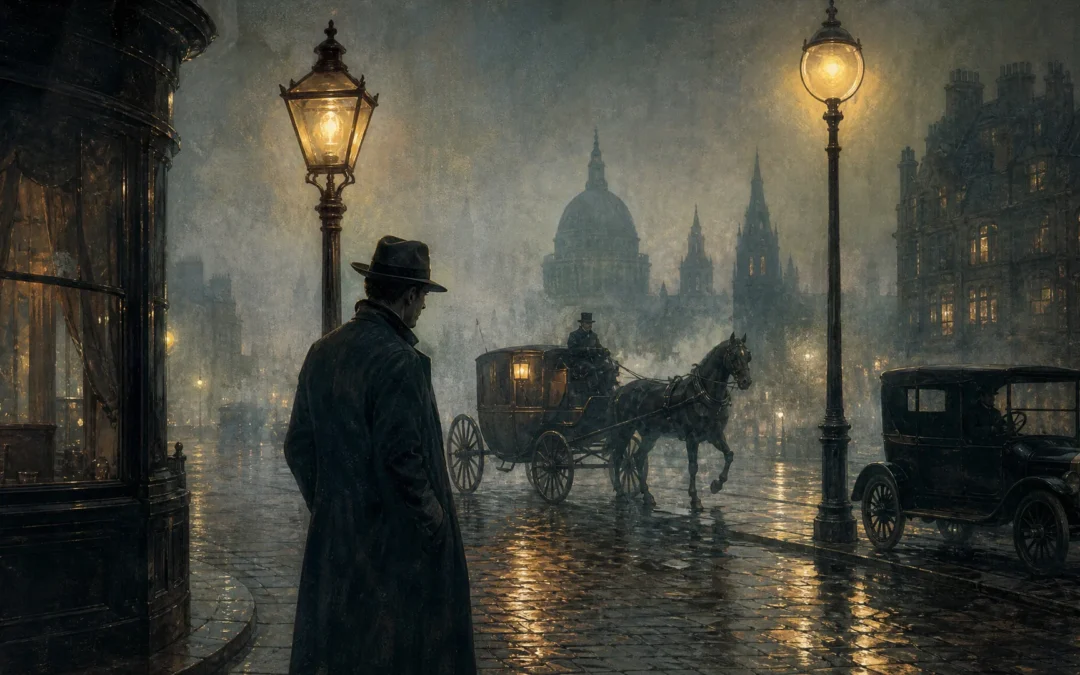
If you’ve ever fallen down the rabbit hole of sherlock holmes mysteries set in london edwardian era, you already know the particular frustration: most search results drop you into either the original Doyle canon, brilliant, but often lumped carelessly under the “Victorian” label, or modern adaptations that use Holmes’s name while quietly abandoning the period entirely. What serious readers of historical london mystery novels are actually hunting for is something more specific: fiction that plants you on a gas-lit, motor-car-rattling London street circa 1902 and keeps you there, faithfully, for three hundred pages. This guide is written for exactly that reader.
Why the Edwardian London Setting Makes Holmes Mysteries Sing
The Edwardian moment: a city between two worlds
Edwardian London, roughly 1901 to 1910, was a city caught between two versions of itself. Horse-drawn hansoms still clattered down the Strand, yet early motor cars were already claiming the same road. Gas lamps still flickered in side streets, while electric arc lights blazed outside music halls. The British Empire stood at its largest territorial extent, yet the social order that had built it was beginning, quietly, to fray at every seam.
For a detective story, that tension is gold. Holmes operates in a world where old certainties are dissolving but the rules haven’t been rewritten yet, which means every case carries an undercurrent of something larger shifting beneath the cobblestones.
How period detail separates great detective fiction from mere pastiche
Readers of historical fiction return to a series not primarily for plot twists but for the sensation of being somewhere real and gone. Accurate social customs, credible geography, the right slang in the right mouth, these are what build trust between an author and an audience. When a period detail rings false, the spell breaks. When it rings true, readers will follow a writer almost anywhere.
That’s the standard edwardian london detective fiction has to meet, and it’s a high one. Getting the era right means more than dressing characters in Edwardian clothes. It means understanding how a woman in 1904 could move through London unchaperoned, what a telegram cost, which districts smelled of which trades, and how a man’s accent placed him socially within the first two sentences he spoke.
The Canon’s Own Edwardian Era: Holmes and the Shifting London Geography
Baker Street, Whitechapel, and the West End: mapping the original cases
We tend to picture Holmes as a Victorian figure, frock coat, gaslight, the fog of the 1880s and 1890s. But the geography Doyle maps is not frozen in time. The East End cases feel grimy and industrial. The West End cases carry the weight of inherited wealth and political consequence. And across the canon, Doyle traces routes, Whitechapel to the Strand, Baker Street to Paddington, with enough precision that you can still walk some of them today.
This London geography is foundational to the sherlock holmes historical setting. The contrast between districts is not atmospheric decoration; it drives plots. A client from Mayfair arriving at Baker Street carries different social stakes than one stumbling in from Stepney, and Holmes reads that difference before the visitor opens their mouth.
Victorian roots, Edwardian bloom: how Doyle’s setting evolved
Here is something popular culture consistently gets wrong: a meaningful portion of the original Doyle canon is set after Queen Victoria’s death in January 1901. The stories collected in His Last Bow (1917), for instance, include cases with internal dates running well into the Edwardian period and beyond. “The Adventure of the Bruce-Partington Plans” is set in 1895, but other stories in that collection push into the reign of Edward VII and even later. Yet marketing and received wisdom persistently label the entire canon “Victorian.”
The distinction matters for readers who care about period authenticity. An Edwardian Holmes is operating in a London where the old queen’s moral gravity has lifted slightly, where suffragette agitation is becoming impossible to ignore, and where the arrival of the automobile is genuinely changing how a suspect might flee a crime scene. That’s a different texture of story than the 1880s cases, even if the same man sits in the same chair at Baker Street.
What Makes a Modern Sherlock Holmes Mystery Feel Authentically Edwardian
Period language, social codes, and the texture of daily life
Craft-wise, authentic period detective stories sherlock readers will trust come down to a handful of specific pressures. Language is the first test: Edwardian English had idioms, rhythms, and registers that differ from both Victorian usage and our own. A character who speaks too modern reads as a costume in a community theatre production.
Social codes are the second pressure. Class in Edwardian London was a system with detailed rules, who called on whom, how a tradesman addressed a gentleman, what it meant for a woman to be “respectable.” A mystery that ignores these codes to move the plot faster has traded authenticity for convenience.
Technology is the third pressure, and it cuts both ways. Edwardian London had telephones, early motor cars, electricity, and a daily newspaper culture. A story that ignores these tools misrepresents the era; a story that introduces them anachronistically, with attitudes characters of 1905 couldn’t plausibly hold, is equally false.
Balancing canon fidelity with fresh narrative perspective
Good continuation fiction holds two things in tension: respect for what Doyle established and the courage to go somewhere Doyle didn’t. The trap most pastiches fall into is choosing one at the expense of the other, either slavish imitation that adds nothing, or bold innovation that leaves the source material behind entirely.
The best contemporary writers in this tradition are disciplined about the line. They know which character traits are load-bearing, Holmes’s methods, Watson’s decency, the texture of London itself, and which are malleable enough to explore without betraying the spirit of the originals. That’s the craft question worth asking of any modern Holmes novel you pick up: does it feel like the author is writing with Doyle, or merely wearing him?
Period Detective Stories in the Sherlock Holmes Tradition Worth Reading
Continuation novels faithful to the Edwardian London world
The field of Holmes continuation fiction is wide, and the quality varies considerably. Among the best Sherlock Holmes books for fans of the original canon, the ones that hold up best over multiple readings share a common trait: they treat Edwardian London as a character in its own right, not a backdrop.
Anthony Horowitz’s authorized continuation novels, The House of Silk (2011) and Moriarty (2014), are frequently praised for their period texture and their faithfulness to Doyle’s narrative voice. Laurie R. King’s Mary Russell series shifts the timeline somewhat, extending into the post-WWI years, but its early volumes capture Edwardian social detail with real precision. For readers who want to map the full range of continuation novels worth reading, the field rewards patient exploration.
The distinguishing test is always specificity. Does the author know which hat a woman of a given class would wear to a given neighborhood in a given season? Do the cab routes feel earned rather than generic? Does the social friction between characters carry real period weight? When those answers are yes, you’re in good hands.
How the Sherlock and Lucy Series Brings Edwardian London to Life
The Sherlock and Lucy series, written by Charles Veley and Anna Elliott, takes a distinctive approach to Edwardian-era Holmes fiction. Its central figure is Lucy James, Holmes’s previously unknown daughter, and the series follows her as she works cases alongside her father in a meticulously researched late-Victorian and Edwardian London. The period detail runs deep: cab routes between Whitechapel and the Strand, the specific weight of social expectations on a young woman moving alone through the city, the small material facts of daily life that make a fictional world feel inhabited rather than staged.
The dual-author structure gives the series an unusual range. Veley brings a plot architect’s discipline; Elliott brings an intimate understanding of what Edwardian life looked and felt like from inside a woman’s experience. Anna Elliott has spoken about the discipline of writing Edwardian women authentically, not softening the real constraints of the era, but finding the documented cracks in those constraints through which a character like Lucy could plausibly operate. That combination produces something rare: a Holmes story that honors canon fidelity while opening corners of Edwardian London that Watson’s narration never visited.
For readers interested in strong female characters in Victorian detective fiction, Lucy James is one of the most carefully grounded examples in the continuation tradition. She is not a modern woman transplanted into period dress. She is a woman of her exact historical moment, which makes her ingenuity, when it appears, feel genuinely earned rather than anachronistic. If you want the full portrait before you begin, Lucy James, Holmes’s daughter and the canon’s heir lays out the character’s origins and place in the series arc in detail.
The series ties its authenticity directly to the craft benchmarks that matter most: period language used with precision, social codes that actually constrain plot rather than decorating it, and a London geography specific enough to map. When Lucy moves through the city, the city pushes back, and that friction is what period detective stories in the Holmes tradition are supposed to feel like.
Where to Start: Reading Order and Next Steps for Edwardian Holmes Fans
If you’ve read this far, you’re not looking for a casual recommendation, you want to get into the material properly. The best starting point for the Sherlock and Lucy series is the first book, following the internal chronology from there. The complete reading order for the Sherlock and Lucy series lays this out clearly, with notes on which volumes work best for readers coming directly from the original Doyle canon and which hold up as standalone entry points.
For the broader tradition of sherlock holmes mysteries set in london edwardian era, the rule of thumb is to start with authors who have done the archival work, writers who can tell you not just what a hansom cab cost in 1903, but what the driver would have said when you got in. Those details are the difference between a Holmes story and a Holmes experience.
Welcome to the era. It’s worth your time.
Recent Comments