
If you’ve spent any time hunting for the best historical fiction books set in London 1900s, you’ll know the frustration: most lists hand you the same handful of sweeping family sagas, then move on. The detective and mystery subgenre, where period London is lived in rather than merely described, gets overlooked almost every time. That gap matters, because crime fiction set in this era does something the broader category rarely manages: it puts you on the street, not just in the drawing room.
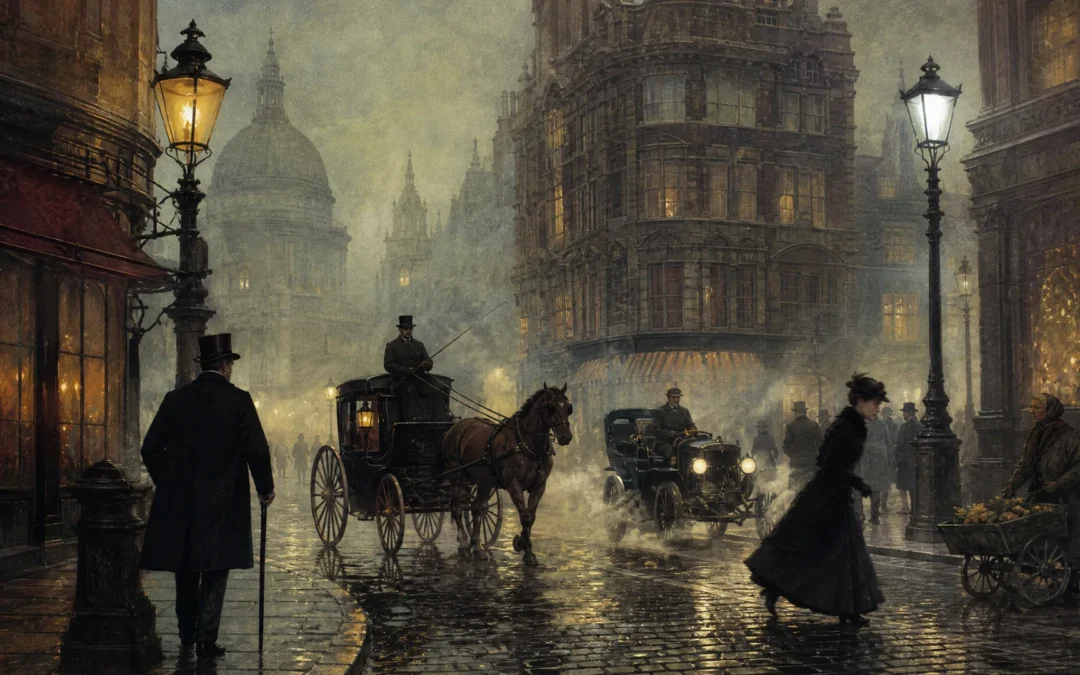
This guide is for readers who want Holmes-era London to feel real under their feet, gas lamps flickering at the edge of electric progress, hansom cabs jostling with early motor cars, a city whose empire was enormous and whose inequalities were sharper still.
Why London’s 1900s Is the Perfect Setting for Historical Fiction
There are periods of history that feel finished, and then there are periods that feel suspended, still reaching toward something. London at the turn of the twentieth century is firmly the latter.
The Edwardian Moment: A City Between Two Eras
Victoria died in January 1901. What she left behind was a city already changing faster than most of its inhabitants could track. Gas lighting was retreating before electric trams and telephone exchanges. The class structure that had organised English life for centuries was cracking under pressure from the suffragette movement, early Labour politics, and the lived contradictions of an empire that preached civilisation while depending on exploitation.
This is exactly the tension that makes Sherlock Holmes mysteries set in Edwardian London so absorbing. The period offers writers, and readers, a world recognisable enough to feel familiar, yet distant enough to feel genuinely foreign. Every cobbled alley, every club in Pall Mall, every overcrowded tenement in Whitechapel carries a charged sense of before: before the war that would end it all in 1914.
For historical fiction, that threshold quality is gold.
What Makes Historical Fiction Set in Early 1900s London Feel Authentic
Surface-level period fiction dresses its characters in bustles and frock coats, drops in a few mentions of fog, and calls it done. Readers who love this era can spot the difference instantly.
Period Research and Setting Detail
Genuine authenticity starts with geography used as social code. Mayfair means old money and entitlement. Baker Street means respectable professional middle class. Whitechapel means poverty, danger, and a community the rest of London prefers to ignore. When a writer moves a character from one district to another, the reader should feel the shift in atmosphere without being told to.
Dialect matters too, not as caricature, but as class marker. A parlour maid doesn’t speak like a barrister. A Limehouse opium den doesn’t sound like a Kensington supper party. The best early 1900s historical fiction earns its period authenticity through these granular choices, not through set-dressing alone.
Real historical events woven into plot, the reform debates, the early motor accidents, the newspaper sensationalism of the day, anchor fiction in a way that invented details simply cannot.
The Role of Social Class and Place
London in 1900 was stratified in ways that touched everything: who used which entrance to a house, who addressed whom by title, who could walk which streets safely after dark. Historical mystery fiction exploits this naturally, because a crime plot has to move its characters across those strata. The detective interviews the cook and the countess. The witness list spans the servant class and the club class. No other genre forces that cross-section so organically.
This is what separates the best period fiction London setting work from the rest: class isn’t window dressing, it’s the engine of the plot.
Best Historical Fiction Books Set in London 1900s: Our Recommended List
The titles below earn their places because they use London as more than backdrop, the city is active in the story, shaping what characters can do and who they can become.
Victorian London Detective Stories With Staying Power
Anne Perry’s Thomas Pitt series (beginning with The Cater Street Hangman, 1979) and her William Monk series (beginning with The Face of a Stranger, 1990) are frequently cited benchmarks for Victorian and Edwardian London authenticity. Perry weaves real districts, Whitechapel tenements, Westminster drawing rooms, into plots driven by class tension and the slow grind of social reform. If you want to understand how great period fiction uses geography as character, start here. For comparable recommendations, the Victorian detective fiction series worth exploring covers several similar titles.
Arthur Conan Doyle’s Sherlock Holmes canon remains the irreducible touchstone. The best Sherlock Holmes books for fans of the original canon offers a structured way back in if you’ve been away from the originals for a while.
Andrew Martin’s Jim Stringer railway detective novels (beginning with The Necropolis Railway, 2002) take a different approach: the Edwardian-era train network and industrial London become both setting and character. Martin demonstrates how period infrastructure, the steam, the soot, the timetables, can anchor historical mystery fiction with a specificity that feels lived rather than researched.
Edwardian London Fiction That Goes Beyond Holmes
Jacqueline Winspear’s Maisie Dobbs series (beginning with Maisie Dobbs, 2003) starts at the close of the First World War but roots itself deeply in Edwardian social structure. Maisie is a working-class woman who rises to become a private investigator, her perspective gives readers access to domestic and professional London simultaneously. For readers drawn to this kind of narrative, mystery novels with female detectives at the centre offers further discovery.
Laurie R. King’s Mary Russell series (beginning with The Beekeeper’s Apprentice, 1994) is a direct Holmes continuation, narrated by a young woman who becomes Holmes’s intellectual partner. It’s widely praised for its period authenticity and its willingness to test Holmes’s world through a modern sensibility. Readers interested in strong female characters in Victorian detective fiction will find plenty to think about here.
Charles Finch’s Charles Lenox series (beginning with A Beautiful Blue Death, 2007) offers a gentler, more ruminative take on Victorian London detective fiction, an amateur detective from the upper-middle classes, navigating reform politics and club culture. The setting is meticulous, and the social texture is unusually warm.
The Genre Intersection: Where Historical Mystery Meets Period Fiction London Setting
Mainstream historical fiction lists tend to reach for the obvious: literary sagas, royal-adjacent narratives, war stories. Detective fiction, despite being one of the most popular categories in all of adult fiction, and despite the strength of Victorian and Edwardian titles published steadily over the past decade, gets sorted into a separate genre ghetto.
That’s a mistake worth correcting, because detective and mystery fiction is structurally the best vehicle for period London immersion. A crime plot forces the author to depict every stratum of society. The investigation visits the servants’ quarters, the Scotland Yard interview room, the slum court, the gentlemen’s club. No other plot logic demands that range.
This is why the difference between Holmes pastiche and continuation fiction matters more than it might seem: continuation novels that take the canon seriously produce setting detail that genuinely rivals, and often surpasses, mainstream literary historical fiction. The detective’s method requires the city. The city, in return, gives the mystery its life.
How the Sherlock & Lucy Series Captures Holmes-Era London
The Sherlock & Lucy series, written by Charles Veley and Anna Elliott, begins where Doyle left gaps, and fills them with period-true fiction grounded in close reading of the original canon. Baker Street geography, Holmes’s documented habits, Edwardian social codes: all of it is present, treated as constraint rather than decoration.
The result is historical fiction early 1900s readers will recognise as genuinely earned, not costume drama, but a world you can inhabit.
Lucy James and the Female Narrative Lens
The series is narrated by Lucy James, Holmes’s previously unknown daughter, and that choice is more than a structural novelty. Co-author Anna Elliott has written about the deliberate decision to centre Lucy precisely because a woman moving through Edwardian London has access to spaces Holmes himself never could. A celebrated consulting detective is conspicuous everywhere he goes. Lucy can move through domestic worlds, below-stairs conversations, and drawing-room confidences in ways that open the period setting to dimensions Doyle’s narrator never reached.
That female narrative lens isn’t a modern imposition, it’s a historically grounded choice. Women in 1900s London occupied every stratum simultaneously: as servants, as society hostesses, as reformers, as invisible infrastructure. Lucy’s perspective makes that visible.
The series has grown across multiple novels, and the reading order guide for the Sherlock & Lucy continuation series is the clearest way to begin, starting with the first book and following the character arc as it deepens.
How to Choose Your Next Period Fiction London Read
The historical fiction early 1900s category is broad enough that “where to start” is a real question worth answering.
If you want atmospheric and cosy, with social texture and character development at the fore, Anne Perry’s Pitt series or Charles Finch’s Lenox novels are natural starting points, rich in period London detail, accessible in tone.
If you want gritty and procedural, Andrew Martin’s Jim Stringer books deliver industrial London with an almost tactile specificity. They’re not comfortable reads, which is part of the point.
If you want canon-adjacent Holmes pastiche, the Baker Street world extended rather than reinvented, Laurie R. King’s Mary Russell series and the Sherlock & Lucy books are the strongest choices currently in print, for different reasons. King goes further from the canon in spirit; Veley and Elliott stay closer to it in letter.
If the female perspective in Edwardian London is what draws you, the access to worlds Holmes and Watson never occupied, then the Sherlock & Lucy series is exactly the right place to start. The reading order guide for the Sherlock & Lucy continuation series will take you through from book one, and the London it builds feels, from the first chapter, like somewhere you’ve been before.
Recent Comments