
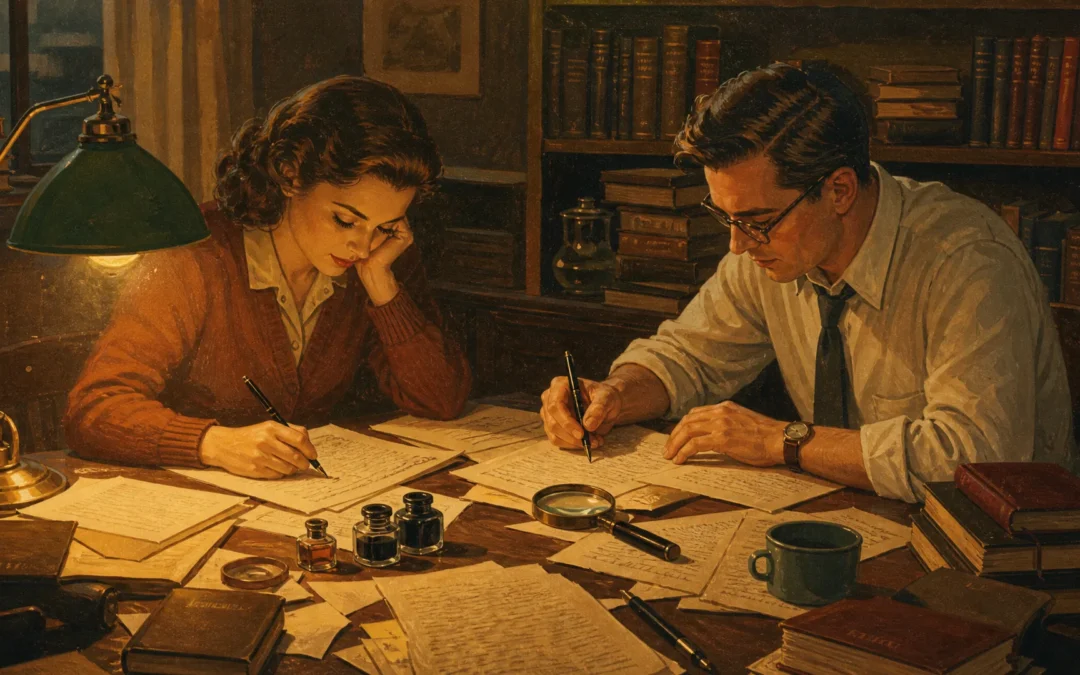
If you’ve just finished a Sherlock and Lucy novel and found yourself searching for the names behind it, you’re not alone. Readers who fall for Lucy James, Sherlock Holmes’s daughter, and the woman carrying his detective legacy into new territory, often want to know who dreamed her up. The answer is Charles Veley and Anna Elliott, two authors whose backgrounds fit together with an almost suspicious neatness. Here’s who they are, how they came to write together, and why the partnership works.
Who Wrote Sherlock and Lucy? Meet the Authors
The short answer: this is a genuine two-author collaboration, not a pen name or a ghostwriting arrangement. Charles Veley and Anna Elliott share credit because they share the work, and each brings a distinct set of instincts to the page. One is a puzzle-builder at heart. The other is a prose stylist steeped in period detail. Together they form the kind of writing partnership that continuation fiction rarely gets right.
Charles Veley: Author Background
Charles Veley came to the Sherlock and Lucy series with a mystery writer’s sensibility, the instinct for clues, misdirection, and the kind of airtight plotting Conan Doyle’s original stories demanded of their readers. That grounding matters in continuation fiction, where a single loose thread can unravel a reader’s trust in the whole enterprise. Veley’s contribution leans on that architecture: cases that hold together, timelines that respect the original canon, and mysteries built to be solved fairly, clue by clue, the way Holmes himself would insist on.
Anna Elliott: Writer Background
Anna Elliott’s background is in historical fiction, a genre that lives or dies on voice, atmosphere, and the texture of a lived-in past. That’s a different muscle than plotting a mystery, and it’s exactly the muscle the Sherlock and Lucy series needs to make Victorian London feel real rather than sketched. Elliott’s writing brings warmth and interiority to characters who could otherwise stay locked in genre convention. Anyone digging into the authors’ biography will notice her sections of the series tend to breathe a little more, lingering on character and setting in ways that complement Veley’s tighter plotting.
The Veley-Elliott Collaboration Story
The Veley-Elliott collaboration didn’t happen because two strangers were assigned to a project. It happened because a mystery plotter and a historical novelist recognized that Sherlock Holmes continuation fiction needed both skill sets to feel whole. Detective fiction demands rigor. Historical fiction demands atmosphere. Few writers excel at both, and rather than compromise on either, Veley and Elliott chose to combine forces.
How the Partnership Began
The origin of any writing partnership is usually less dramatic than readers imagine. It tends to come down to two people recognizing complementary strengths and deciding the work would be stronger together than apart. For Veley and Elliott, that meant pairing a writer who thinks in clues and consequences with a writer who thinks in character and place. The result is a series that reads like it was built by a single mind with an unusually wide range, when in fact it’s the product of two.
Dividing the Creative Work
Co-authors of long-running series often describe splitting duties between plot architecture and prose voice, and that division has become something of a hallmark for well-executed continuation fiction. It’s a pattern worth understanding if you’re curious about how co-authored mystery novels typically come together: one author maps the case, the suspects, and the resolution, while the other shapes how it all feels on the page, the dialogue, the description, the emotional beats. Veley and Elliott’s own working relationship follows that same broad logic, letting each writer focus on what they do best rather than forcing one person to be equally strong at everything.
Why Two Authors Instead of One
It would have been simpler, in some ways, for either Veley or Elliott to write the series alone. But continuation fiction carries a burden original fiction doesn’t: it has to satisfy readers who already know and love the source material, while still telling a story worth reading on its own terms. A solo author writing Sherlock Holmes continuation fiction has to be equally gifted at mystery construction and literary atmosphere, and that combination is rare. By working as a pair, Veley and Elliott split that burden in a way that plays to genuine strengths rather than papering over gaps. The result is plotting rigorous enough for a mystery reader and prose textured enough for a historical fiction reader, both served in the same books.
Building Lucy James: A Shared Vision for Holmes’s Daughter
The defining creative decision of the entire series is Lucy James herself, Sherlock Holmes’s previously unknown daughter, and the character who lets Veley and Elliott open new story territory without contradicting a single word of Conan Doyle’s original casework. That’s not a small trick to pull off. It took both authors’ skills at once: plot logic strong enough to explain how such a daughter could exist unmentioned in the original stories, and a character voice rich enough to make her feel earned rather than gimmicky. Lucy James, the canon’s heir, works because she was built jointly. Veley’s structural reasoning gives her a plausible place in Holmes’s history; Elliott’s character work gives her an inner life of her own. Readers interested in the broader tradition of the Sherlock Holmes daughter character in literature will find that Lucy stands out precisely because she wasn’t conceived as a novelty. She was conceived as a structural solution two authors arrived at together.
Sherlock and Lucy Authors’ Biography: Credibility and Canon Respect
Part of what makes Charles Veley and Anna Elliott’s biography worth reading is the reassurance it offers skeptical fans. Sherlock Holmes has inspired more than a century of pastiche, adaptation, and continuation, and not all of it treats Conan Doyle’s original work with care. Veley and Elliott co-write the Sherlock and Lucy series directly, and their shared author notes and behind-the-book reflections are published on sherlockandlucy.com for readers who want the story behind the story. That transparency matters. It signals that this is a collaboration built by two named, accountable authors, not a faceless brand exercise.
Balancing Reverence for Conan Doyle with New Storytelling
Readers who care about canon fidelity tend to ask a fair question: does adding a daughter to Sherlock Holmes’s life betray the original stories, or does it build on them respectfully? The distinction that matters here is the difference between pastiche and true continuation fiction. Veley’s grounding in classic mystery structure means the new cases respect the deductive method Conan Doyle established, while Elliott’s historical fiction craft means the Victorian setting never feels like a costume. Together, that’s the combination readers cite most often as the reason Lucy James feels like a fully realized addition to the Holmes canon rather than a gimmick. It’s also worth situating Elliott’s contribution alongside other female authors writing Sherlock Holmes pastiches, part of a growing tradition of writers expanding whose stories get told in this world, and how.
Where to Start Reading Sherlock and Lucy
Once you know who wrote Sherlock and Lucy, the natural next question is where to begin. The series is built to be read in order, since the mysteries and Lucy’s own arc develop case by case, much as Conan Doyle’s original stories built on each other over the decades. For readers curious about the gap the authors chose to fill, what happened to Sherlock Holmes after Doyle’s final story, that’s exactly the territory Veley and Elliott step into with Book 1. If you’re new to the series, start there and follow where to start with the Sherlock and Lucy reading order from the beginning. Now that you’ve met the authors, meeting their detective is the obvious next step.
Recent Comments