
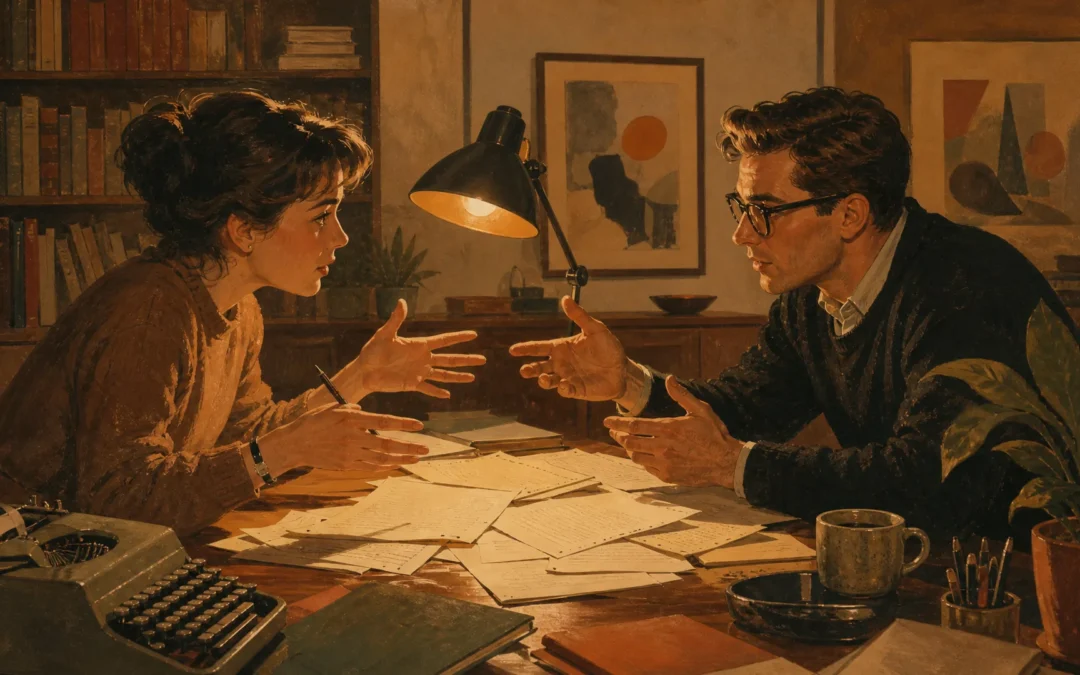
Two writers, one story, zero seams visible to the reader, that is the quiet achievement at the heart of co-authored mystery fiction. It sounds simple enough in theory, but anyone who has tried to write even a short story with a partner knows how quickly creative instincts collide. Yet mystery fiction has a long and quietly distinguished history of exactly this kind of partnership. Understanding how it works, and why it can work so well, is its own kind of mystery worth solving.
Why Mystery Fiction Is Built for Collaboration
The genre’s structure lends itself to two minds
A mystery novel is, at its core, an argument. Every chapter proposes something, a clue, a suspicion, a misdirection, and the whole structure only works if every promise is eventually honoured. That demands a kind of internal logic that benefits enormously from scrutiny. One author writing alone can convince themselves that a plot thread holds together; a second author asking “but wait, how did she know that?” is the best editorial instrument a mystery writer can have.
The architecture of detective fiction, layered clues, planted red herrings, a reveal that must feel both surprising and inevitable, creates natural division points. One mind can build the puzzle; another can walk through it as a first reader. That dynamic, built into the collaboration from the start, tends to produce tighter, more honestly tested plots than a solo author reviewing their own work.
A long tradition of dual authorship in detective fiction
This is not a new idea. [Ellery Queen](https://en.wikipedia.org/wiki/Ellery Queen), the pen name shared by cousins Frederic Dannay and Manfred Bennington Lee, is one of the most successful co-authored detective fiction partnerships in history. They produced dozens of novels from the late 1920s onward, establishing a template for how two writers can sustain a unified voice across a long series. Neither name appeared alone; neither writer tried to own the identity. The character and the byline became a third thing, distinct from either individual.
That tradition runs through how Holmes shaped the modern detective novel and continues into contemporary publishing, where dual-byline series appear regularly across cozy mystery, historical detective fiction, and procedural sub-genres. Readers have little resistance to, and often genuine enthusiasm for, knowing a book came from two minds.
How Do Co-Authors Write a Novel Together? The Core Models
Most working partnerships settle into one of a few recognizable models.
Dividing the work: plot vs. prose
The most structurally clean approach assigns distinct roles by skill. One author architects the plot, building the outline, seeding the clues, mapping the red herrings, deciding where the body falls and who put it there. The other takes that scaffold and writes the actual prose: the sentences, the scenes, the voice. James Patterson’s brand of collaborative authorship works roughly this way, he provides detailed outlines and co-authors complete the prose, a structured role division that has produced some of the most commercially successful thriller and mystery series of recent decades.
This model works well when the two writers have genuinely different strengths. The plotter thinks in logic and structure; the prose writer thinks in character and rhythm. Together they cover ground that neither would cover as well alone. The division is clean enough that each person knows their lane.
Alternating chapters and unified voice
The other common model is chapter alternation, each author writes complete chapters, then both revise across the full manuscript until the seams disappear. This approach demands more editorial work in the back half, but it can produce a more genuinely merged voice because both writers are present in every part of the story. The risk is inconsistency: a clue planted in chapter three by one author needs to pay off in chapter nineteen written by the other, which requires careful shared notes and a willingness to revise ruthlessly.
Some partnerships combine both approaches: they outline together, alternate drafts, and then one author does a final pass for voice consistency. The key is that the process is agreed upon before the first word is written, not negotiated mid-manuscript.
The Unique Challenges of Collaborative Writing in Mystery
Collaborative writing in mystery fiction carries challenges that don’t appear in the same form in other genres. The most acute is clue continuity. In a thriller, a minor inconsistency might go unnoticed. In a detective novel, a reader who has been paying careful attention will catch it, and will feel, rightly, that the contract has been broken. When two authors are maintaining that web of planted evidence across a shared manuscript, a single miscommunication can unravel a reveal that took chapters to build.
Voice consistency is the second major challenge. Readers build a relationship with a narrator’s particular rhythms, the way she notices things, the slight irony in how she describes men who underestimate her, the texture of her inner life. If that voice shifts noticeably between chapters, it breaks the spell. Both authors need to hold the character’s interiority as a shared object, something they’ve discussed deeply enough that they each know how she would phrase a thought she’s never been asked to phrase before.
Series continuity adds a third layer. The longer a collaborative mystery series runs, the more each new book must be consistent not just with the co-author’s current draft but with everything both authors have written before. A detail from book two can become a plot problem in book seven. This is where shared series bibles, documents tracking every named character, every established fact about the world, every unresolved thread, become essential infrastructure.
Inside the Sherlock and Lucy Collaboration: A Behind-the-Scenes Look
How Charles Veley and Anna Elliott divide the creative work
The Sherlock and Lucy series, written by Charles Veley and Anna Elliott, is a working example of co-authored mystery done well. Charles brings careful Doyle canon research and intricate plot architecture. He thinks in puzzles: how the crime was committed, where the evidence points, how the mystery echoes or departs from Conan Doyle’s originals. Anna brings Lucy James, Holmes’s previously unknown daughter, her voice, her emotional world, her experience navigating Victorian London as a sharp woman in a world designed to overlook her.
The result is a collaboration where neither author’s contribution is visible in isolation. They merge into a single storytelling identity. The plot holds because one writer has tested it against the full weight of the canon. The voice holds because the other writer has lived inside the character long enough to know exactly how she sees.
Staying true to Doyle while building something new
This is where the collaboration becomes something more than a craft question. Building a continuation series means understanding the difference between pastiche and continuation fiction, and committing to the heavier responsibility of continuation. You are not writing in the spirit of Conan Doyle; you are extending the actual world he built. Every fact about Holmes, Watson, and Victorian London must hold. Every new character must feel like she could have existed in those pages.
Having two writers committed to that standard, one checking canonical accuracy, the other ensuring emotional authenticity, means the series can carry both rigour and warmth. Neither alone would guarantee both.
What Makes a Co-Authored Mystery Series Feel Seamless to Readers
Readers of co-authored fiction often report, on discovering the dual authorship, a mild surprise. The book didn’t feel like two people. That seamlessness comes from a few specific things working together.
First, a single strong protagonist anchors everything. When the character’s voice is consistent, when strong female characters in Victorian detective fiction feel like real, complete people rather than plot functions, readers orient around that character rather than around the prose texture. Lucy James serves this function in the Sherlock and Lucy series. She is the constant. When readers pick up book five, they are returning to her, and that continuity overrides any subtle differences in how each author approaches a sentence.
Second, unified revision matters as much as unified drafting. The final manuscript needs to sound like one person wrote it, which means both authors need the discipline to revise each other’s prose without ego. Many writing pairs describe their process as something like a long-running conversation: one partner proposes, the other interrogates, and the story that emerges is stronger for having survived two sets of instincts. The adversarial affection of a great collaboration is, in this sense, not unlike the dynamic between Holmes and Watson themselves.
Third, shared genre knowledge creates consistency below the surface. Two writers who have both read deeply in mystery fiction, who share instincts about what a fair clue looks like, what pacing a reveal requires, will make similar choices intuitively, even in separate drafts.
Finding and Choosing a Co-Author: What Works in Practice
If you are drawn to collaborative writing in mystery, the most important thing to establish before you begin is whether you share a vision for the world and the characters, not just the plot of the first book, but the emotional logic of the whole series. What kind of person is your protagonist, at her core? What does she want that she cannot yet say out loud? If two writers cannot agree on that, no division of labour will save the manuscript.
Complementary strengths matter more than equal skills. Two brilliant prose stylists who both want to write the scenes and neither wants to build the plot will stall at chapter three. Two plot architects who can build intricate puzzle structures but find voice and interiority difficult will produce books that feel cold. Honest self-assessment, and honest assessment of a potential partner, is more valuable than enthusiasm.
Communication cadence is practical but critical. Co-authoring a novel is a long project measured in months, not days. Misunderstandings that go unaddressed for a week compound. Most successful writing partnerships check in frequently, keep shared documents current, and treat disagreements as editorial conversations rather than personal disputes.
Finally, read each other’s solo work first. Voice is hard to fake and hard to suppress. If you cannot imagine your potential co-author’s prose merging with yours, if reading their pages makes you want to rewrite every sentence rather than build on it, that is information worth having before you commit to a series.
The best co-authored mystery series feel like they came from one remarkable mind. That illusion takes two people, and considerable craft, to sustain. If you’d like to see what that craft looks like from the reader’s side, the reading order for the Sherlock and Lucy continuation series is the natural place to start, a series built, book by book, on exactly the kind of collaboration this article describes.
Recent Comments