
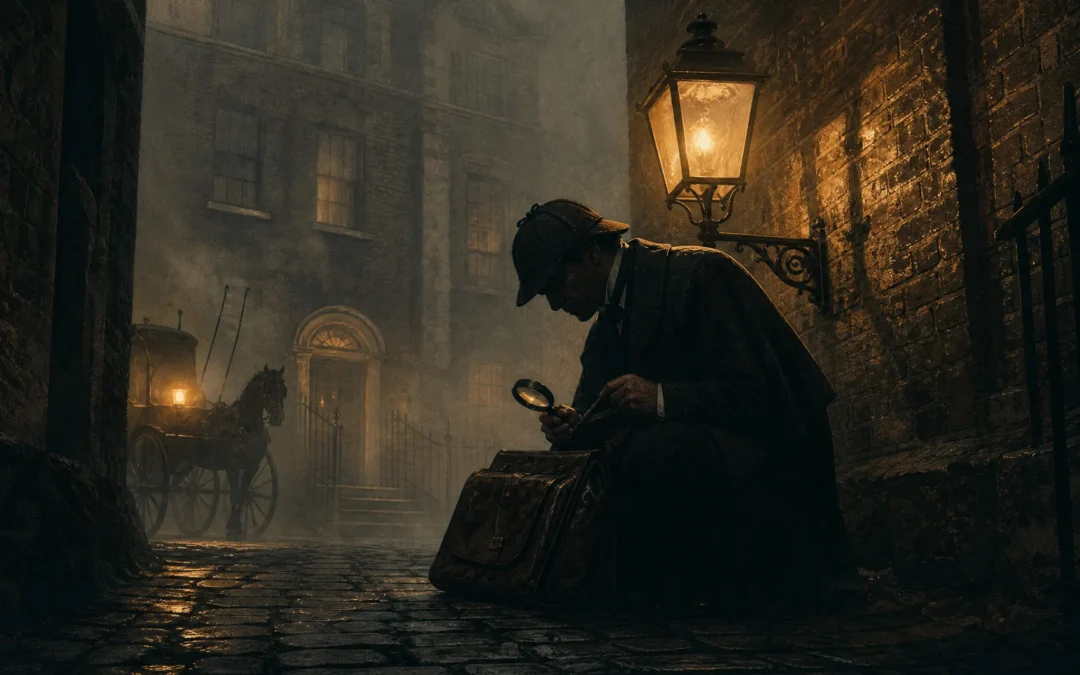
Pick up almost any list of classic mystery fiction and you’ll find the same handful of sentences about foggy streets and gaslight. What those lists rarely explain is why that setting matters at all. Why does a mystery set in a real, richly textured Victorian London work on readers in a way that a vague “old-timey city” never could? Setting isn’t wallpaper here. It’s an engine that generates clues, tension, and character.
Why Victorian London History Matters in Detective Stories
A detective story lives or dies on its constraints. Who could plausibly be where, at what hour, seen by whom? Victorian London history in detective stories supplies those constraints for free. A city of narrow courts, gas lamps, and rigid social boundaries hands the writer a built-in logic of alibis and suspicion.
That’s different from simply dressing a plot in period costume. When the setting is authentic, geography itself becomes evidence. A character’s address tells you their income. Their mode of transport tells you their haste. Their neighborhood tells you who they’re allowed to know.
What Readers Actually Notice About Period Detail
Readers rarely stop to admire a well-researched hansom cab route. What they notice is subtler: a story that never trips over its own century. They notice when a character’s manners, money, and movements all line up with the world around them.
Most guides to detective fiction treat “Victorian setting” as a single flavor, worth a paragraph before moving on to plot summaries. Few explain how the historical detail actually functions inside the narrative, how it creates the very obstacles and clues the detective must untangle. That connection between real place and living plot is the piece worth understanding.
The Real 1890s London Behind Sherlock Holmes Historical Accuracy
Sherlock Holmes historical accuracy in London depends on Arthur Conan Doyle’s decision to root his detective in a city that actually existed. Baker Street, the Diogenes Club, the Thames-side wharves weren’t invented backdrops. Conan Doyle anchored fictional crimes to real London geography: fog-bound Baker Street, the Diogenes Club, the docks of the East End. That gave Holmes an authority pure invention couldn’t match.
That grounding matters because readers of the 1890s could check the map. A story that got the city wrong would have felt as false then as a modern thriller getting a real airport layout wrong feels today. Doyle’s confidence with real streets let him build a fictional detective readers were willing to trust.
Streets, Fog, and Landmarks That Shaped the Stories
The London fog wasn’t just atmosphere. Coal smoke and river damp combined into a genuine hazard that could hide a pursuer or delay a cab. Gas lighting left long stretches of street in near-darkness. That’s exactly the kind of detail a mystery plot can use.
Hansom cabs gave characters a fast, semi-private way to cross the city, and Holmes uses them constantly to track movements and timings. Wikipedia’s overview of Victorian London shows how thoroughly the era’s infrastructure, from railways to the Underground’s early lines to the docks, shaped who could plausibly get where, and when.
How Class and Geography Created Built-In Conflict
Victorian London sorted people by postcode almost as rigidly as by title. A gentleman’s club in the West End and a lodging house in Whitechapel were, in effect, different worlds a few miles apart. By the 1890s, London had grown into the largest city in the world, with a population well past four million. That density and diversity of neighborhoods gave detective fiction an almost inexhaustible supply of settings, from Mayfair drawing rooms to Whitechapel lodging houses.
That density is a gift to a mystery writer. Every crossing of class lines carries built-in tension: a lord seeking Holmes’s help, a servant with a secret, a foreign visitor in over their head. The city itself makes that crossing unusual.
Victorian London Setting Mystery vs. Edwardian London in Mysteries
A Victorian London setting mystery and one set in the Edwardian years can look similar on the surface. Both feature gaslit streets, hansom cabs, and a detective in a frock coat. But the texture underneath shifts in ways attentive readers will feel even if they can’t name them.
What Changes Between 1890 and 1901
The shift from gas lamps to early electric lighting, the rise of the telephone, and the growing presence of women in public professional life mark the difference between a story set in 1888 and one set in 1901. Queen Victoria’s death in 1901 didn’t change London overnight, but it marked a hinge point the culture had already been leaning toward.
Motorcars begin to share the street with horse-drawn traffic. Women push further into offices, universities, and professional life, changing what a “respectable” plot involving a female character can plausibly include. A mystery set in these years can use that shifting ground as its own kind of clue about how fast the world is moving. Readers curious about that later texture can find it explored directly in Sherlock Holmes mysteries set in Edwardian London, where the changing city becomes part of the story rather than just its backdrop.
How Historical Detail Integration Strengthens Detective Narrative
The craft challenge for any writer of period detective fiction is integration, not decoration. Nobody wants a paragraph explaining Victorian sewage systems dropped into the middle of a chase. The historical detail has to arrive through action, through what a character notices, touches, or has to work around.
A locked door tells you more about a house’s history if you know when that lock design came into use. An alibi holds up, or falls apart, based on train timetables a writer actually checked rather than guessed at. Good period fiction hides its research inside the plot, so the reader absorbs the era without ever feeling lectured to.
Research Habits That Keep Period Fiction Honest
In writing the Sherlock and Lucy novels, Charles Veley and Anna Elliott research period newspapers, maps, and social history so that Lucy James’s London feels lived-in rather than sketched from memory of other pastiches. They check what a real 1890s newspaper reported on a given week, or how a particular street actually ran, rather than relying on the shorthand version of Victorian London that other pastiches have already worn smooth.
Readers interested in how that process works in more depth can look at how Charles Veley and Anna Elliott approach research, which lays out the habits behind the series’ period detail. It’s the same instinct that drives any careful historical novelist: check it, don’t assume it.
Experiencing 1890s London Detective Fiction Through Lucy James’s Eyes
Most 1890s London detective fiction gives readers Holmes and Watson’s view of the city: two educated men moving through clubs, cabs, and crime scenes with a certain freedom. Lucy James, as Holmes’s daughter and a young American actress finding her footing in London, sees the city from a different angle entirely.
Her perspective opens up spaces the classic canon barely touched: theaters and the working lives of actresses, the particular constraints on a young woman moving through London alone, the friction of being an American navigating British class assumptions. That’s not a departure from the historical setting. It’s an expansion of it, using the same real London but a different set of doors into it.
Readers who enjoy that kind of vantage point, a sharp, capable woman working inside a rigidly ordered world, may also want to look at period detective fiction with smart heroines, a shelf where Lucy James has good company. The city doesn’t change. The eyes taking it in do, and that’s often where a familiar setting starts to feel new again.
Where to Start Reading Victorian and Edwardian Detective Fiction Today
If this deep dive into setting has you wanting to read rather than just read about reading, the good news is there’s no shortage of doors in. Readers who want a wider survey before committing to one series can start with historical fiction books set in 1900s London, or look at Victorian detective fiction series for adult readers to compare how different authors handle the same era.
But if what you want is Holmes’s London extended rather than replaced, the same fog and streets seen through new eyes and carried forward into the Edwardian years, the Sherlock and Lucy novels were built for exactly that reading experience. The series takes the historical grounding Conan Doyle established and keeps it honest across two decades of London’s changing life.
The best way to see whether that combination of authentic period detail and fresh perspective works for you is simply to begin. You can start the Sherlock and Lucy reading order and step into a London that’s as carefully built as it is well loved.
Recent Comments