
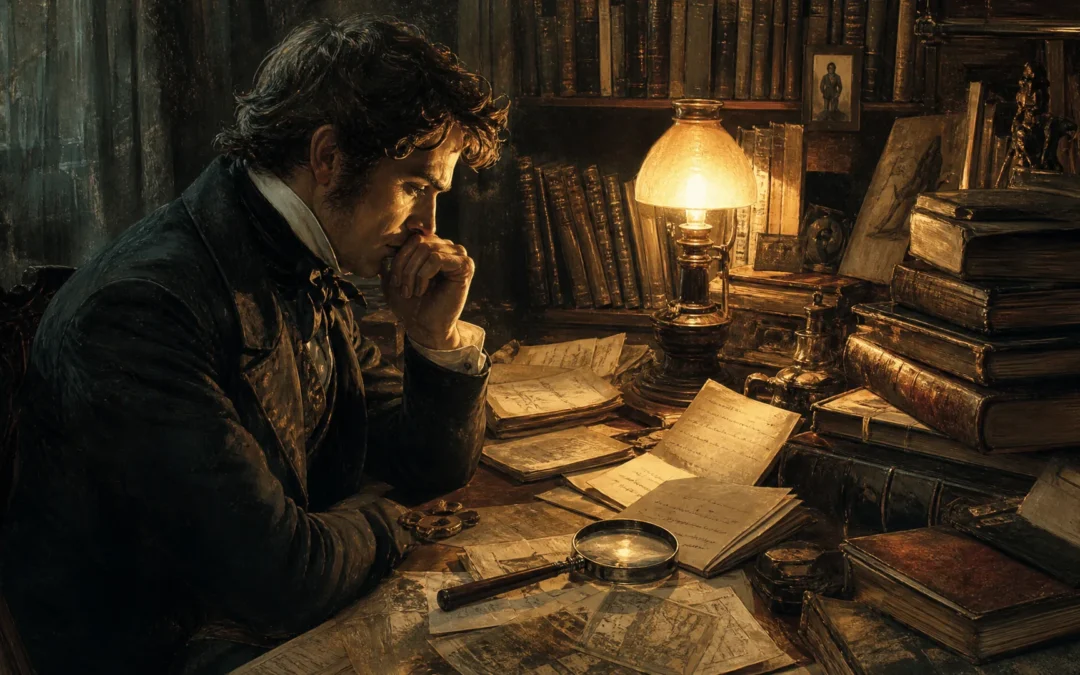
Every few months, a new “sherlock holmes adaptations ranked best to worst” list appears online. They follow the same pattern: BBC Sherlock at the top, Jeremy Brett somewhere close behind, a nod to the Guy Ritchie films, and perhaps a mention of Enola Holmes to stay current. Then the list ends. No prose. No stage. Certainly no books beyond Doyle himself. If you are a devoted reader of the canon, or of the continuation fiction that has grown up around it, these lists feel like ranking restaurants while ignoring the kitchen. This guide is the corrective version, written by canon readers, for canon readers, that treats every serious Holmes adaptation as a legitimate contender regardless of medium.
Why Most ‘Best Sherlock Holmes Adaptations’ Lists Get It Wrong
Popular ranking articles are built around search volume, and search volume follows screens. That is why virtually every ranked list focuses on television and film, with literary adaptations treated as a footnote, if they appear at all. The result is a skewed picture of Holmes’s cultural legacy.
Holmes was a literary creation before he was a screen icon, and the prose form has continued to produce serious, canon-faithful work for over a century. Adrian Conan Doyle and John Dickson Carr’s 1954 collaboration The Exploits of Sherlock Holmes, published by John Murray, is one of the earliest and most discussed attempts to extend the canon in prose, establishing a benchmark that later continuation writers have measured themselves against. You will not find it on any mainstream “ranked” list.
A genuinely useful ranking accounts for all media. This one does.
The Gold Standard: Canonical Screen Adaptations Ranked
Television: Where Holmes Found His Modern Audience
The Granada Television series starring Jeremy Brett (1984–1994) is widely regarded among Holmes scholars and enthusiasts as the most faithful screen adaptation ever produced. Brett drew directly on Doyle’s original descriptions of Holmes’s mercurial temperament, physical restlessness, and emotional volatility. The production team worked from the stories themselves, not from prior screen interpretations. Period authenticity was meticulous. For canon fidelity alone, Granada sits at the top of any honest television ranking.
BBC Sherlock (2010–2017) brought Holmes to a global audience and won multiple BAFTA and Emmy awards. Its first two series demonstrated that Doyle’s plots and characters could survive transplantation into the twenty-first century. Its later series, though, drew sustained criticism, from purists and casual fans alike, for departing significantly from the character relationships Doyle established. High on style and character energy, lower on canon fidelity.
CBS’s Elementary (2012–2019) relocated Holmes to New York, gender-swapped Watson, and leaned into procedural structure. It found a devoted audience and handled addiction themes with care. As a reimagining it is ambitious; as a canonical adaptation it ranks lower, because the distance from Doyle’s originals is the whole point.
Netflix’s Enola Holmes films (2020, 2022) are charming, kinetic, and deliberately designed for a new generation. Henry Cavill’s Holmes is warmer than Doyle wrote him. The stories centre Holmes’s sister rather than Holmes himself. As Victorian detective fiction series for adult readers go, they are enjoyable, but they function more as period adventure films than canonical Holmes adaptations.
Film: From Basil Rathbone to Robert Downey Jr.
Basil Rathbone’s fourteen-film run (1939–1946) defined screen Holmes for a generation. The Universal wartime entries updated the setting to the 1940s, which dates them oddly now, but Rathbone’s aquiline precision still feels close to Doyle’s original in tone. His is the performance against which every subsequent film Holmes is measured.
Guy Ritchie’s Sherlock Holmes (2009) and A Game of Shadows (2011), with Robert Downey Jr. recast Holmes as a brawling action hero. They are entertaining films on their own terms and genuinely capture Holmes’s physical unpredictability and eccentric brilliance. Canon fidelity, however, is selective. Ritchie takes Doyle’s ingredients and makes something quite different from the source material.
For canon fidelity in film, the 1970 Billy Wilder picture The Private Life of Sherlock Holmes, often underrated, offers more interiority and period texture than the action blockbusters that followed it.
Sherlock Holmes Books vs TV Shows: What the Screen Can’t Capture
The Case for Literary Adaptations and Continuation Novels
Holmes scholars have long noted that Watson’s first-person narration is the structural engine of Doyle’s stories. It controls what the reader knows, and when. That controlled release of information is what makes the mysteries work: we see what Watson sees, and Holmes’s reasoning arrives as revelation rather than process. Screen adaptations must externalise all reasoning visually, the spinning mind palace, the annotated pause, the deductive overlay, and in doing so they make Holmes’s process visible too early. The mystery flattens.
Prose preserves what cameras cannot: the fog of Baker Street before the solution, the warmth of Watson’s admiration, the exact texture of Victorian London as a social world rather than a production design. These are not minor pleasures. They are the experience of Holmes.
This is why the difference between pastiche and continuation fiction matters so much in any serious ranking. A pastiche borrows Holmes’s silhouette. A continuation novel works from the canon outward, using Doyle’s established characters, settings, and chronology as a foundation, then extending the story rather than reinventing it. The best continuation novels give readers something no screen version can: a Holmes who is still entirely Doyle’s, encountered fresh.
Sherlock Holmes Versions Compared: A Complete Ranking Across All Media
How We Scored Canon Fidelity, Character, and Craft
A consistent framework makes a cross-media ranking trustworthy. We used four criteria, weighted equally:
- Canon fidelity, how closely does the adaptation respect Doyle’s characters, plots, and established world?
- Characterisation, does Holmes feel like Holmes? Does Watson have his own intelligence and agency?
- Period authenticity, does the adaptation commit to its chosen era, rather than using it decoratively?
- Originality within constraints, does the work add something new without contradicting what exists?
Applying this framework across media produces a ranking that looks quite different from the standard TV-only list:
- Granada TV / Jeremy Brett, near-perfect canon fidelity, extraordinary characterisation, period commitment throughout
- The best continuation novels (Veley & Elliott, among others), high fidelity, full period authenticity, adds meaningfully to the world
- BBC Sherlock (series 1–2), superb characterisation, strong originality, modernisation reduces both fidelity and period scores
- Basil Rathbone films (pre-war), solid fidelity and characterisation, best film-era Holmes on screen
- Guy Ritchie films, high entertainment value, strong character energy, moderate fidelity
- CBS Elementary, excellent characterisation in its own terms, low canon fidelity by design
- Enola Holmes, enjoyable period adventure, Holmes is a supporting character in his own world
- BBC Sherlock (series 3–4), declining fidelity and period authenticity, though still compelling television
For readers who want to explore the literary end of this spectrum, best Sherlock Holmes books for fans of the original canon is the natural place to continue.
The Hidden Tier: Continuation Novels That Rival the Best Screen Adaptations
Screen adaptations get the cultural oxygen. Continuation novels, when they are good, often deserve a seat at the same table, and the best of them do things that television simply cannot.
The Veley & Elliott Lucy James series belongs in any honest discussion of continuation novels worth reading for Holmes fans. The series applies a deliberately canon-faithful lens: Victorian and Edwardian settings, Doyle’s established characters, and period-accurate social dynamics. The narrative centres Lucy James, Holmes’s previously unknown daughter, as narrator, which gives readers a new point of entry into the canon without contradicting it. Lucy sees Holmes from a different angle than Watson does. She is close enough to understand him, distant enough to be surprised by him.
Working through a female-led narrative lens also does something the Granada series, for all its fidelity, could not do: it opens Doyle’s closed world to a voice that was present in Victorian London but largely absent from the original stories. The social textures of the period, what a woman could know, investigate, or admit to, become part of the mystery itself. That is originality within constraints, which scores well in any rigorous evaluation.
For readers curious about how the Sherlock Holmes daughter character appears in literature, the Veley & Elliott series is a natural starting point and one of the most carefully constructed entries in the continuation tradition.
Understanding how Holmes shaped modern detective fiction also helps explain why continuation fiction matters: Holmes is not a closed property. He is a structural model that serious writers have extended, tested, and inhabited for well over a century. The Veley & Elliott series is one of the stronger recent examples of that tradition done with genuine craft.
Which Sherlock Holmes Adaptation Is Right for You?
The honest answer is that the right adaptation depends on what you are actually looking for.
If you want binge-watchable television with strong performances and modern pacing, BBC Sherlock’s first two series are the obvious entry point. Follow them with Granada if you want to understand what the character looks like at maximum fidelity.
If you are a canon purist who has read all four novels and fifty-six stories, the screen adaptations will likely leave you wanting. The continuation novel tier, especially writers working in Doyle’s period and with Doyle’s cast, is where your next Holmes experience probably lives.
If you are new to Holmes entirely and want something accessible, the Guy Ritchie films or BBC Sherlock will bring you in quickly. Then read the originals. Then come back to the continuation novels with fresh eyes.
If you are looking for a series that respects the canon, deepens the world, and gives you a new narrator worth trusting, the Veley & Elliott Lucy James books are worth your time. Start with the reading order for Holmes continuation series and begin with book one, it is designed to welcome readers who know Doyle well and those just arriving in Baker Street for the first time alike.
What the best Sherlock Holmes adaptations, in any medium, share is simple: they take the source material seriously. They do not use Holmes as decoration. They engage with who he actually is on the page, and they build outward from there with care. That standard applies whether the work runs on a screen or sits in your hands. The adaptations that meet it are worth your time. The ones that don’t, no ranking can rescue.
Recent Comments